
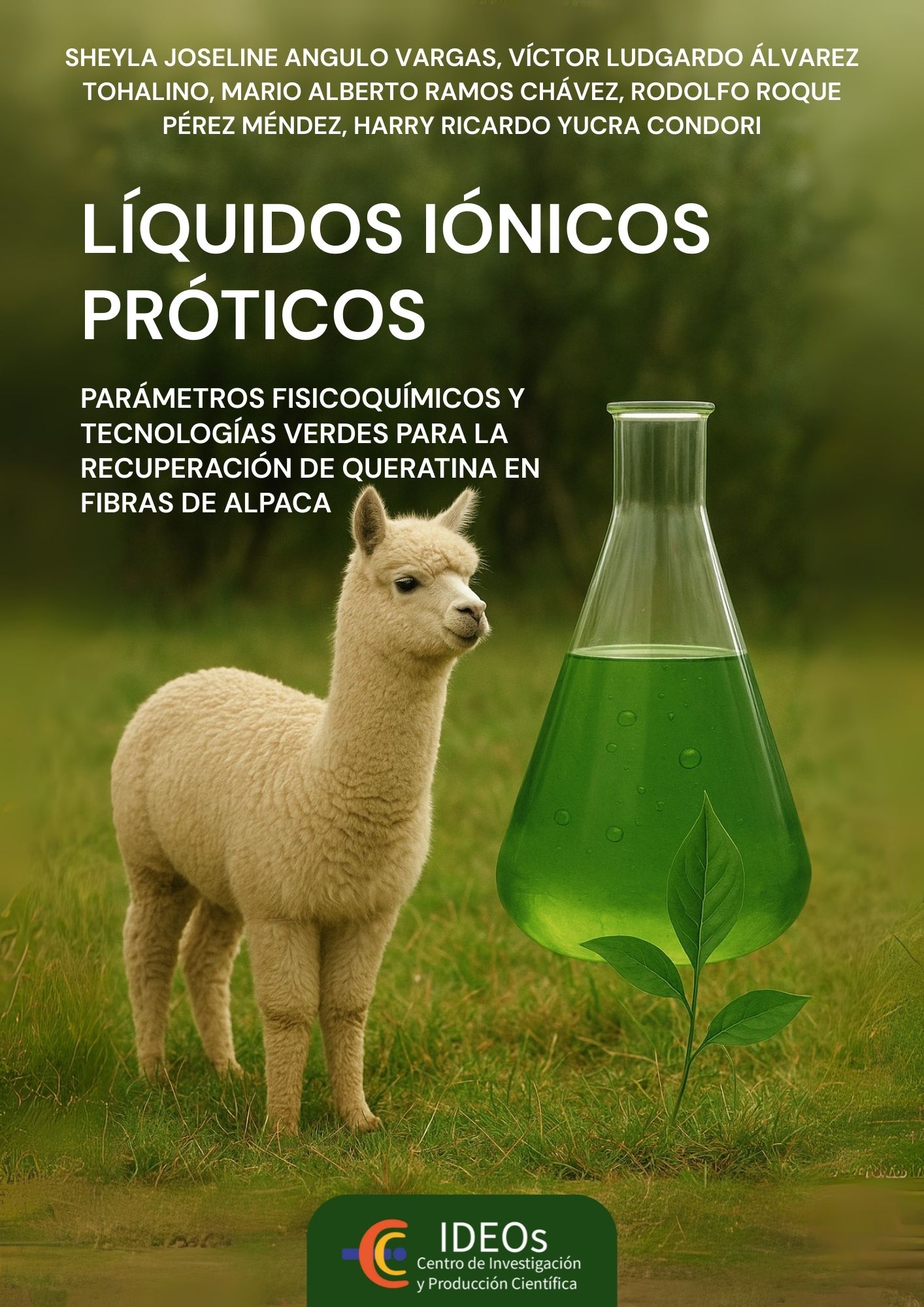
Líquidos Iónicos Próticos
Parámetros Fisicoquímicos y Tecnologías Verdes para la Recuperación de Queratina en Fibras de Alpaca
Resumen
El estudio de las fibras naturales ha cobrado un creciente interés en las últimas décadas, no solo por su valor económico y cultural, sino también por el potencial que poseen en aplicaciones científicas, biomédicas e industriales. En este contexto, la queratina, una proteína fibrosa que constituye el componente estructural de pelos, plumas, uñas y fibras animales, se presenta como un recurso de gran relevancia. Su particular resistencia mecánica, insolubilidad en agua y elevada estabilidad frente a agentes químicos han limitado durante mucho tiempo las técnicas para su extracción y aprovechamiento, aunque en la actualidad se cuenta con nuevos enfoques que permiten superar estas dificultades.
Citas
Adam, C., Bravo, M. V., & Mancini, P. M. E. (2014). Molecular solvent effect on the acidity constant of protic ionic liquids. Tetrahedron Letters, 55, 148–150.
Allen, M. E., D. F., & Lumry, R. J. (1985). Solution Chem, 14, 549.
Álvarez, V. H., Mattedi, S., Martin-Pastor, M., Aznar, M., & Iglesias, M. (2010). Synthesis and thermophysical properties of two new protic long-chain ionic liquids with the oleate anion. Fluid Phase Equilibria, 299, 42–50.
Andersson, G., & Ridings, C. (2014). Ion scattering studies of molecular structure at liquid surfaces with applications in industrial and biological systems. Chemical Reviews, 114, 8361–8387.
Anouti, M., Vigeant, A., Jacquemin, J., Brigouleix, C., & Lemordant, D. (2010). Volumetric properties, viscosity and refractive index of the protic ionic liquid, pyrrolidinium octanoate, in molecular solvents. The Journal of Chemical Thermodynamics, 42, 834–845.
Baghbanian, S. M., & Farhang, M. (2013). Protic [TBD][TFA] ionic liquid as a reusable and highly efficient catalyst for N-formylation of amines using formic acid under solvent-free condition. Journal of Molecular Liquids, 183, 45–49.
Bagno, A. B., C., Chiappe, C., D’amico, F., Lord, J. C. D., & Pieraccini, D. R. (2005). Org. Biomol. Chem, 3, 1624.
Binnemans, K. (2005). Ionic liquid crystals. Chemical Reviews, 105, 4148–4204.
Binnemans, K. (2007). Lanthanides and actinides in ionic liquids. Chemical Reviews, 107, 2592–2614.
Bonhote, P. D., A. P., Papageorgiou, N., Kalyanasundaram, K., & Gratzel, M. (1996). Inorg. Chem, 35, 1168.
Bulaj, G. (2005). Formation of disulfide bonds in proteins and peptides. Biotechnology Advances, 23, 87.
Cardamone, J. M. (2010). Investigating the microstructure of keratin extracted from wool: Peptide sequence (MALDI-TOF/TOF) and protein conformation (FTIR). Journal of Molecular Structure, 969, 97.
Chhotaray, P. K., & Gardas, R. L. (2014). Thermophysical properties of ammonium and hydroxylammonium protic ionic liquids. The Journal of Chemical Thermodynamics, 72, 117–124.
Devlin, T. M. (2004). Bioquímica: Libro de texto con aplicaciones químicas (p. 126).
Dupont, J., de Souza, R. F., & Suarez, P. A. Z. (2002). Ionic liquid (molten salt) phase organometallic catalysis. Chemical Reviews, 102, 3667–3692.
Eysaguirre, M. P. (2012). Análisis científico de fibras arqueológicas. Conserva, 6.
Fortunati, E., Aluigi, A., Armentano, I., Morena, F., Emiliani, C., Martino, S., Santulli, C., Torre, L., Kenny, J. M., & Puglia, D. (2015). Keratins extracted from Merino wool and Brown Alpaca fibres: Thermal, mechanical and biological properties of PLLA based biocomposites. Materials Science and Engineering: C, 47, 394–406.
Ghosh, A., Clerens, S., Deb-Choudhury, S., & Dyer, J. M. (2014). Thermal effects of ionic liquid dissolution on the structures and properties of regenerated wool keratin. Polymer Degradation and Stability, 108, 108–115.
Govinda, V., Madhusudhana Reddy, P., Bahadur, I., Attri, P., Venkatesu, P., & Venkateswarlu, P. (2013). Effect of anion variation on the thermophysical properties of triethylammonium based protic ionic liquids with polar solvent. Thermochimica Acta, 556, 75–88.
Greaves, T. L., & Drummond, C. J. (2008). Protic ionic liquids: Properties and applications. Chemical Reviews, 108, 206–237.
Greaves, T. L., & Drummond, C. J. (2008). Protic ionic liquids: Properties and applications. Chemical Reviews, 108, 206–237.
Harrap, B. S., & Heymann, E. (1951). Theories of viscosity applied to ionic liquids. Chemical Reviews, 48, 45–67.
Haumann, M., & Riisager, A. (2008). Hydroformylation in room temperature ionic liquids (RTILs): Catalyst and process developments. Chemical Reviews, 108, 1474–1497.
Hayes, R., Warr, G. G., & Atkin, R. (2015). Structure and nanostructure in ionic liquids. Chemical Reviews, 115, 6357–6426.
Hirao, M. S., H., & Ohno, H. (2000). J. Electrochem. Soc, 147, 4168.
Hoerning, A., Ribeiro, F. R. G., Cardozo Filho, L., Lião, L. M., Corazza, M. L., & Voll, F. A. P. (2016). Boiling point elevation of aqueous solutions of ionic liquids derived from diethanolamine base and carboxylic acids. The Journal of Chemical Thermodynamics, 98, 1–8.
Hou, M., Xu, Y., Han, Y., Chen, B., Zhang, W., Ye, Q., & Sun, J. (2013). Thermodynamic properties of aqueous solutions of two ammonium-based protic ionic liquids at 298.15K. Journal of Molecular Liquids, 178, 149–155.
Idris, A., Vijayaraghavan, R., Patti, A. F., & MacFarlane, D. R. (2014). Distillable protic ionic liquids for keratin dissolution and recovery. ACS Sustainable Chemistry & Engineering, 2, 1888–1894.
Ji, Y., Chen, J., Lv, J., Li, Z., Xing, L., & Ding, S. (2014). Extraction of keratin with ionic liquids from poultry feather. Separation and Purification Technology, 132, 577–583.
Kulhavy, J., Andrade, R., Barros, S., Serra, J., & Iglesias, M. (2016). Influence of temperature on thermodynamics of protic ionic liquid 2-hydroxy diethylammonium lactate (2-HDEAL) + short hydroxylic solvents. Journal of Molecular Liquids, 213, 92–106.
Lang, X.-D., Yu, Y.-C., Li, Z.-M., & He, L.-N. (s.f.). Protic ionic liquids-promoted efficient synthesis of quinazolines from 2-aminobenzonitriles and CO2 at ambient conditions. Journal of CO2 Utilization.
Lei, Z., Dai, C., & Chen, B. (2014). Gas solubility in ionic liquids. Chemical Reviews, 114, 1289–1326.
Lira, E. M. P. (2002). Análisis científico de fibras arqueológicas. Conserva, 6.
Losetty, V., Chennuri, B. K., & Gardas, R. L. (2016). Synthesis, spectroscopic characterization and acoustic, volumetric, transport and thermal properties of hydroxyl ammonium based ionic liquids. The Journal of Chemical Thermodynamics, 92, 175–181.
MacFarlane, D. R., Pringle, J. M., Johansson, K. M., Forsyth, S. A., & Forsyth, M. (2006). Chemical Communications, 1905.
Morante, R., F. G., A. B., I. C., & M. A. P.-C., J. P. G. (2003). Genetic improvement for alpaca fibre production in the Peruvian Altiplano: the Pacomarca experience. Animal Genetic Resources Information, 45, 37–43.
Moschovi, A. M., Ntais, S., Dracopoulos, V., & Nikolakis, V. (2012). Vibrational spectroscopic study of the protic ionic liquid 1-H-3-methylimidazolium bis(trifluoromethanesulfonyl)imide. Vibrational Spectroscopy, 63, 350–359.
Mumford, K. A., Pas, S. J., Linseisen, T., Statham, T. M., Johann Nicholas, N., Lee, A., Kezia, K., Vijayraghavan, R., MacFarlane, D. R., & Stevens, G. W. (2015). Evaluation of the protic ionic liquid, N,N-dimethyl-aminoethylammonium formate for CO₂ capture. International Journal of Greenhouse Gas Control, 32, 129–134.
Noda, A., Susan, M. A. B. H., Kudo, K., Mitsushima, S., Hayamizu, K., & Watanabe, M. (2003). Journal of Physical Chemistry B, 107, 4024.
Nuthakki, B. G., Krodkiewska, I., Weerawardena, A., Burgar, M. I., & Drummond, C. J. (2007). Australian Journal of Chemistry, 60, 21.
Oliveira, L. M. C., Ribeiro, F. R. G., Alcantara, M. L., Pisoni, G. O., Cabral, V. F., Cardozo-Filho, L., & Mattedi, S. (s.f.). High pressure vapor-liquid equilibria for binary methane and protic ionic liquid based on proprionate anions. Fluid Phase Equilibria.
Oliveira, M. V. S., Vidal, B. T., Melo, C. M., de Miranda, R. d. C. M., Soares, C. M. F., Coutinho, J. A. P., Ventura, S. P. M., Mattedi, S., & Lima, Á. S. (2016). (Eco)toxicity and biodegradability of protic ionic liquids. Chemosphere, 147, 460–466.
Peric, B., Sierra, J., Martí, E., Cruañas, R., & Garau, M. A. (2014). A comparative study of the terrestrial ecotoxicity of selected protic and aprotic ionic liquids. Chemosphere, 108, 418–425.
Peric, B., Sierra, J., Martí, E., Cruañas, R., Garau, M. A., Arning, J., Bottin-Weber, U., & Stolte, S. (2013). (Eco)toxicity and biodegradability of selected protic and aprotic ionic liquids. Journal of Hazardous Materials, 261, 99–105.
Pinkert, A., Marsh, K. N., Pang, S., & Staiger, M. P. (2009). Ionic liquids and their interaction with cellulose. Chemical Reviews, 109, 6712–6728.
Plaquevent, J.-C., Levillain, J., Guillen, F., Malhiac, C., & Gaumont, A.-C. (2008). Ionic liquids: New targets and media for α-amino acid and peptide chemistry. Chemical Reviews, 108, 5035–5060.
Ranke, J., Stolte, S., Störmann, R., Arning, J., & Jastorff, B. (2007). Design of sustainable chemical products: The example of ionic liquids. Chemical Reviews, 107, 2183–2206.
Rashid, T., Kait, C. F., Regupathi, I., & Murugesan, T. (2016). Dissolution of kraft lignin using protic ionic liquids and characterization. Industrial Crops and Products, 84, 284–293.
Renda, C. M., Patel, Y. K., Henshaw, L. R., Munson, K. T., Fiebig, O. C., Tran, A. T., Shriver, J., Cruz, J., Yu, L., & Vaden, T. D. (2016). Thermodynamic and conductivity properties of acetic acid — EMIMOAc ionic liquid solutions. Journal of Molecular Liquids, 216, 710–715.
Russina, O., Caminiti, R., Méndez-Morales, T., Carrete, J., Cabeza, O., Gallego, L. J., Varela, L. M., & Triolo, A. (2015). How does lithium nitrate dissolve in a protic ionic liquid? Journal of Molecular Liquids, 205, 16–21.
Santos, D., Costa, F., Franceschi, E., Santos, A., Dariva, C., & Mattedi, S. (2014). Synthesis and physico-chemical properties of two protic ionic liquids based on stearate anion. Fluid Phase Equilibria, 376, 132–140.
Sharma, G., Gardas, R. L., Coronas, A., & Venkatarathnam, G. (2016). Effect of anion chain length on physicochemical properties of N,N-dimethylethanolammonium based protic ionic liquids. Fluid Phase Equilibria, 415, 1–7.
Singh, V., Chhotaray, P. K., Banipal, P. K., Banipal, T. S., & Gardas, R. L. (2015). Volumetric properties of amino acids in aqueous solutions of ammonium based protic ionic liquids. Fluid Phase Equilibria, 385, 258–274.
Talavera-Prieto, N. M. C., Ferreira, A. G. M., Simões, P. N., Carvalho, P. J., Mattedi, S., & Coutinho, J. A. P. (2014). Thermophysical characterization of N-methyl-2-hydroxyethylammonium carboxilate ionic liquids. The Journal of Chemical Thermodynamics, 68, 221–234.
van Rantwijk, F., & Sheldon, R. A. (2007). Biocatalysis in Ionic Liquids. Chemical Reviews, 107, 2757–2785.
Wang, Y.-X., & Cao, X.-J. (2012). Extracting keratin from chicken feathers by using a hydrophobic ionic liquid. Process Biochemistry, 47, 896–899.
Watanabe, H., Doi, H., Saito, S., Matsugami, M., Fujii, K., Kanzaki, R., Kameda, Y., & Umebayashi, Y. (s.f.). Hydrogen bond in imidazolium based protic and aprotic ionic liquids. Journal of Molecular Liquids.
Watanabe, M., Nakayama, C., Yasuda, H., Harada, M., & Iida, M. (2016). Interactions of nickel(II) ions in protic ionic liquids comprising N-hexyl(or N-2-ethylhexyl)ethylenediamines. Journal of Molecular Liquids, 214, 77–85.
Welton, T. (1999). Room-Temperature Ionic Liquids. Solvents for Synthesis and Catalysis. Chemical Reviews, 99, 2071–2084.
Xiao, L., Su, D., Yue, C., & Wu, W. (2014). Protic ionic liquids: A highly efficient catalyst for synthesis of cyclic carbonate from carbon dioxide and epoxides. Journal of CO₂ Utilization, 6, 1–6.
Xu, W., Cooper, E. I., & Angell, C. A. (2003). Journal of Physical Chemistry B, 107, 6170.
Yoshizawa, M., Xu, W., & Angell, C. A. (2003). Journal of the American Chemical Society, 125, 15411.
Zhou, Z. B. M., H., & Tatsumi, K. (2004). Chem. Lett, 33, 1636.
Zhou, Z. B. M., H., & Tatsumi, K. (2005). Chem.-Eur. J., 11, 752.
Descargas
Publicado
Cómo citar
Número
Sección
Licencia

Esta obra está bajo una licencia internacional Creative Commons Atribución 4.0.
El autor permite el uso y difusión de los artículos a los lectores y a la revista, por medio de la licencia Creative Commons CC-BY-4.0 (Reconocimiento 4.0). Esta licencia permite que cualquiera distribuya, remezcle, adapte y rediseñe a partir de un trabajo, incluso con fines lucrativos, siempre que se mencione la autoría de la creación original.
Ruta CC-BY-4.0: https://creativecommons.org/licenses/by/4.0/


