
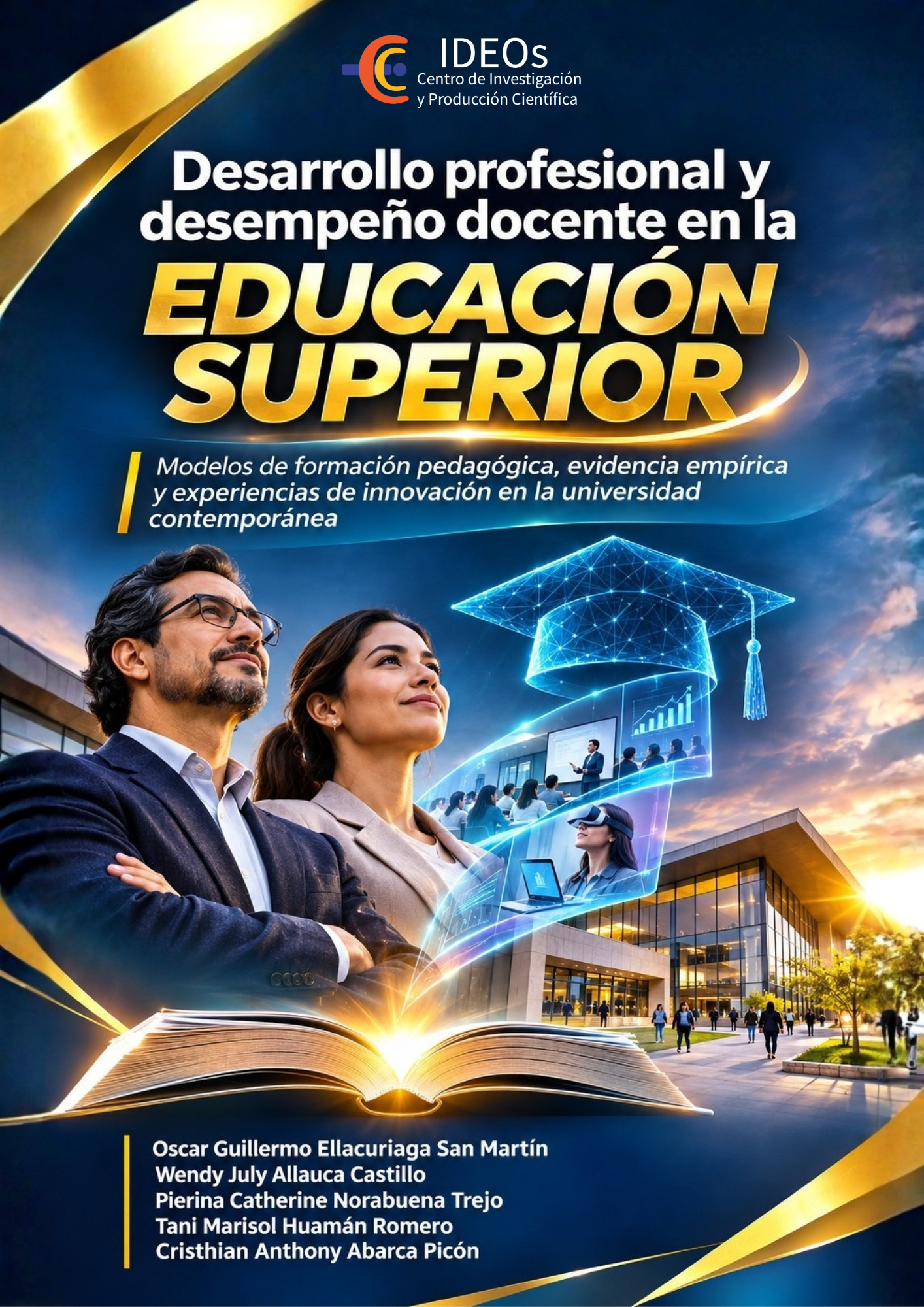
Desarrollo profesional y desempeño docente en la educación superior
Modelos de formación pedagógica, evidencia empírica y experiencias de innovación en la universidad contemporánea
Abstract
Enseñar en la universidad nunca ha sido una tarea simple, pero hoy exige una inteligencia profesional que va más allá de la mera exposición de contenidos. El conocimiento científico se expande, los campos de trabajo se transforman y el alumnado llega con experiencias profundamente heterogéneas. En estas condiciones, el profesor necesita mantener el rigor disciplinar y, al mismo tiempo, diseñar situaciones que permitan apropiarse críticamente del saber. La mejora de la educación superior se juega en la intersección entre el conocimiento, la mediación y la responsabilidad pública.
Este libro parte de una convicción abierta a discusión: el desarrollo pedagógico de los académicos no debería considerarse una actividad periférica respecto de la investigación y la gestión, sino una dimensión constitutiva de la vida universitaria. La docencia produce preguntas intelectuales legítimas sobre cómo se aprende, cómo se evalúa, cómo se organiza una experiencia compartida y cómo una institución puede reconocer las dificultades que ella misma genera. Abordar estas preguntas requiere teoría y, con igual necesidad, la observación rigurosa de situaciones reales.
La formación profesional del profesorado no se reduce a añadir técnicas. Una universidad puede multiplicar seminarios y certificaciones sin modificar las prácticas de aula. También puede implementar tecnología avanzada y mantener intactas las mismas relaciones de transmisión. Lo decisivo es conectar la experiencia formativa con el razonamiento docente, con productos de trabajo contrastables y con la posibilidad de revisar lo que no ha funcionado. Desde esa perspectiva, la innovación es menos una colección de novedades que una forma organizada de aprender de la práctica.
La investigación que inspira esta obra ofrece una oportunidad concreta para examinar esas relaciones. No porque un solo programa cierre el debate, sino porque convierte en objeto de análisis un problema frecuente en las universidades: cómo fortalecer la preparación pedagógica de docentes que poseen saber experto, pero enfrentan exigencias crecientes para enseñar, evaluar, acompañar e investigar su propio trabajo. El caso deja ver posibilidades, tensiones y desafíos metodológicos que importan tanto como las cifras favorables.
A lo largo del libro se propone una lectura que no confunde el deseo de mejora con su demostración. El respeto por los participantes, por la universidad y por quienes puedan adaptar estas experiencias exige conservar las pruebas disponibles, identificar sus límites y abrir preguntas nuevas. La evidencia científica pierde valor cuando se la obliga a responder más de lo que realmente mide. Gana, en cambio, capacidad transformadora cuando orienta decisiones proporcionales a su calidad.
Formar mejores docentes es, en último término, ampliar las posibilidades de aprender con dignidad y exigencia. Es construir universidades capaces de debatir sus métodos con la misma seriedad con que debaten sus resultados de investigación. El desafío no pertenece únicamente a un grupo de especialistas: involucra a autoridades, facultades, estudiantes, unidades de calidad y comunidades académicas. Esta obra invita a asumirlo con curiosidad crítica, responsabilidad institucional y confianza en la posibilidad de mejorar mediante trabajo compartido.
References
Bandura, A. (1997). Self-efficacy: The exercise of control. W. H. Freeman.
Biggs, J., & Tang, C. (2011). Teaching for quality learning at university (4th ed.). McGraw-Hill/Open University Press.
Bélisle, M., Jean, V., & Fernandez, N. (2024). The educational development of university teachers: Mapping the landscape. Frontiers in Education, 9, 1376658. https://doi.org/10.3389/feduc.2024.1376658
Brummer, L., de Boer, H., Mouw, J. M., & Strijbos, J.-W. (2024). A meta-analysis of the effects of context, content, and task factors of digitally delivered instructional feedback on learning performance. Learning Environments Research, 27, 453–476. https://doi.org/10.1007/s10984-024-09501-4
Carless, D., & Winstone, N. (2023). Teacher feedback literacy and its interplay with student feedback literacy. Teaching in Higher Education, 28(1), 150–163. https://doi.org/10.1080/13562517.2020.1782372
Chaharbashloo, H., Talebzadeh, H., Hosseini Largani, M., & Amirian, S. (2024). A systematic review of online teaching competencies in higher education context: A multilevel model for professional development. Research and Practice in Technology Enhanced Learning, 19, 014. https://doi.org/10.58459/rptel.2024.19014
Chi, M. T. H., & Wylie, R. (2014). The ICAP framework: Linking cognitive engagement to active learning outcomes. Educational Psychologist, 49(4), 219–243. https://doi.org/10.1080/00461520.2014.965823
Danielson, C. (2013). The framework for teaching: Evaluation instrument (2013 ed.). The Danielson Group.
Darling-Hammond, L. (2017). Empowered educators: How high-performing systems shape teaching quality around the world. Jossey-Bass.
Donath, J. L., Lüke, T., Graf, E., Tran, U. S., & Götz, T. (2023). Does professional development effectively support the implementation of inclusive education? A meta-analysis. Educational Psychology Review, 35, Article 30. https://doi.org/10.1007/s10648-023-09752-2
Duan, S., Bissaker, K., & Xu, Z. (2024). Correlates of teachers’ classroom management self-efficacy: A systematic review and meta-analysis. Educational Psychology Review, 36, Article 43. https://doi.org/10.1007/s10648-024-09881-2
Ellacuriaga San Martín, O. G., Allauca Castillo, W. J., Norabuena Trejo, P. C., Huamán Romero, T. M., & Abarca Picón, C. A. (2026). Programa de formación pedagógica del profesor universitario para mejorar su desempeño docente en la Universidad Santiago Antúnez de Mayolo, 2024 [Informe final de investigación]. Universidad Nacional Santiago Antúnez de Mayolo.
Gansemer-Topf, A. M., Mendee, A., & Braxton, J. M. (2024). Guiding principles and processes of scholarship of teaching and learning and scholarship of practice. New Directions for Student Services, 2024(185), 61–69. https://doi.org/10.1002/ss.20506
Gordillo, M., & Prado, V. (2024). Formación docente y práctica pedagógica en la educación inclusiva: Revisión sistemática. Ciencia y Educación, 8(2), 75–93. https://doi.org/10.22206/ciened.2024.v8i2.pp75-93
Jensen, I. B., & Dikilitas, K. (2025). A scoping review of action research in higher education: Implications for research-based teaching. Teaching in Higher Education, 30(1), 84–101. https://doi.org/10.1080/13562517.2023.2222066
Kaliisa, R., Jivet, I., & Prinsloo, P. (2023). A checklist to guide the planning, designing, implementation, and evaluation of learning analytics dashboards. International Journal of Educational Technology in Higher Education, 20, Article 28. https://doi.org/10.1186/s41239-023-00394-6
Korthals Altes, T., Willemse, M., Goei, S. L., & Ehren, M. (2024). Higher education teachers’ understandings of and challenges for inclusion and inclusive learning environments: A systematic literature review. Educational Research Review, 43, 100605. https://doi.org/10.1016/j.edurev.2024.100605
Kozanitis, A., & Nenciovici, L. (2023). Effect of active learning versus traditional lecturing on the learning achievement of college students in humanities and social sciences: A meta-analysis. Higher Education, 86, 1377–1394. https://doi.org/10.1007/s10734-022-00977-8
Kraft, M. A., Blazar, D., & Hogan, D. (2018). The effect of teacher coaching on instruction and achievement: A meta-analysis of the causal evidence. Review of Educational Research, 88(4), 547–588. https://doi.org/10.3102/0034654318759268
Lindvall, J., Kirsten, N., Ryve, A., & Gustafsson, J.-E. (2025). A critical review and meta-analysis of studies investigating the effects of the professional development teachers typically receive. Studies in Educational Evaluation, 86, 101482. https://doi.org/10.1016/j.stueduc.2025.101482
Martella, A. M., & Schneider, D. (2024). A reflection on the current state of active learning research. Journal of the Scholarship of Teaching and Learning, 24(3). https://doi.org/10.14434/josotl.v24i3.35263
Miao, F., & Cukurova, M. (2024). AI competency framework for teachers. UNESCO. https://doi.org/10.54675/ZJTE2084
Miao, F., & Holmes, W. (2023). Guidance for generative AI in education and research. UNESCO. https://doi.org/10.54675/EWZM9535
OECD. (2024). Education policy outlook 2024: Reshaping teaching into a thriving profession from ABCs to AI. OECD Publishing. https://doi.org/10.1787/dd5140e4-en
OECD. (2023). OECD digital education outlook 2023: Towards an effective digital education ecosystem. OECD Publishing. https://doi.org/10.1787/c74f03de-en
Quansah, F., Cobbinah, A., Asamoah-Gyimah, K., & Hagan, J. E., Jr. (2024). Validity of student evaluation of teaching in higher education: A systematic review. Frontiers in Education, 9, 1329734. https://doi.org/10.3389/feduc.2024.1329734
Redecker, C. (2017). European framework for the digital competence of educators: DigCompEdu (Y. Punie, Ed.). Publications Office of the European Union. https://doi.org/10.2760/159770
Shadish, W. R., Cook, T. D., & Campbell, D. T. (2002). Experimental and quasi-experimental designs for generalized causal inference. Houghton Mifflin.
Shulman, L. S. (1987). Knowledge and teaching: Foundations of the new reform. Harvard Educational Review, 57(1), 1–22.
Smith, B., & Wyness, L. (2025). What makes professional teacher development in universities effective? Lessons from an international systematised review. Professional Development in Education, 51(7), 1550–1572. https://doi.org/10.1080/19415257.2024.2386666
UNESCO. (2023). Global education monitoring report 2023: Technology in education—A tool on whose terms? UNESCO. https://gem-report-2023.unesco.org/
UNESCO & International Task Force on Teachers for Education 2030. (2024). Global report on teachers: Addressing teacher shortages and transforming the profession. UNESCO. https://www.unesco.org/en/articles/global-report-teachers-addressing-teacher-shortages-and-transforming-profession
Visscher, A. J., Dmoshinskaia, N., Pellegrini, M., & Rey-Naizaque, A. (2025). (When) do teacher professional development interventions improve student achievement? A meta-analysis of 128 high-quality studies. Educational Research Review, 49, 100742. https://doi.org/10.1016/j.edurev.2025.100742
Wiggins, G., & McTighe, J. (2005). Understanding by design (2nd ed.). ASCD.
Wong Lam, L. J., & Carrillo Luna, S. (2026). Programas de capacitación para el fortalecimiento de competencias didácticas en docentes universitarios en Iberoamérica: Una revisión sistemática. Desde el Sur, 18(2), e0037. https://doi.org/10.21142/des-1802-2026-0037
Zhou, X., Shu, L., Xu, Z., & Padrón, Y. (2023). The effect of professional development on in-service STEM teachers’ self-efficacy: A meta-analysis of experimental studies. International Journal of STEM Education, 10, Article 37. https://doi.org/10.1186/s40594-023-00422-x
Downloads
Published
How to Cite
Issue
Section
License

This work is licensed under a Creative Commons Attribution 4.0 International License.
This license allows others to redistribute, remix, tweak, and build upon your work, even with commercial penalties, as long as you take credit for the original creation. This is the most helpful license offered. Recommended for maximum dissemination and use of the materials subject to the license.


