
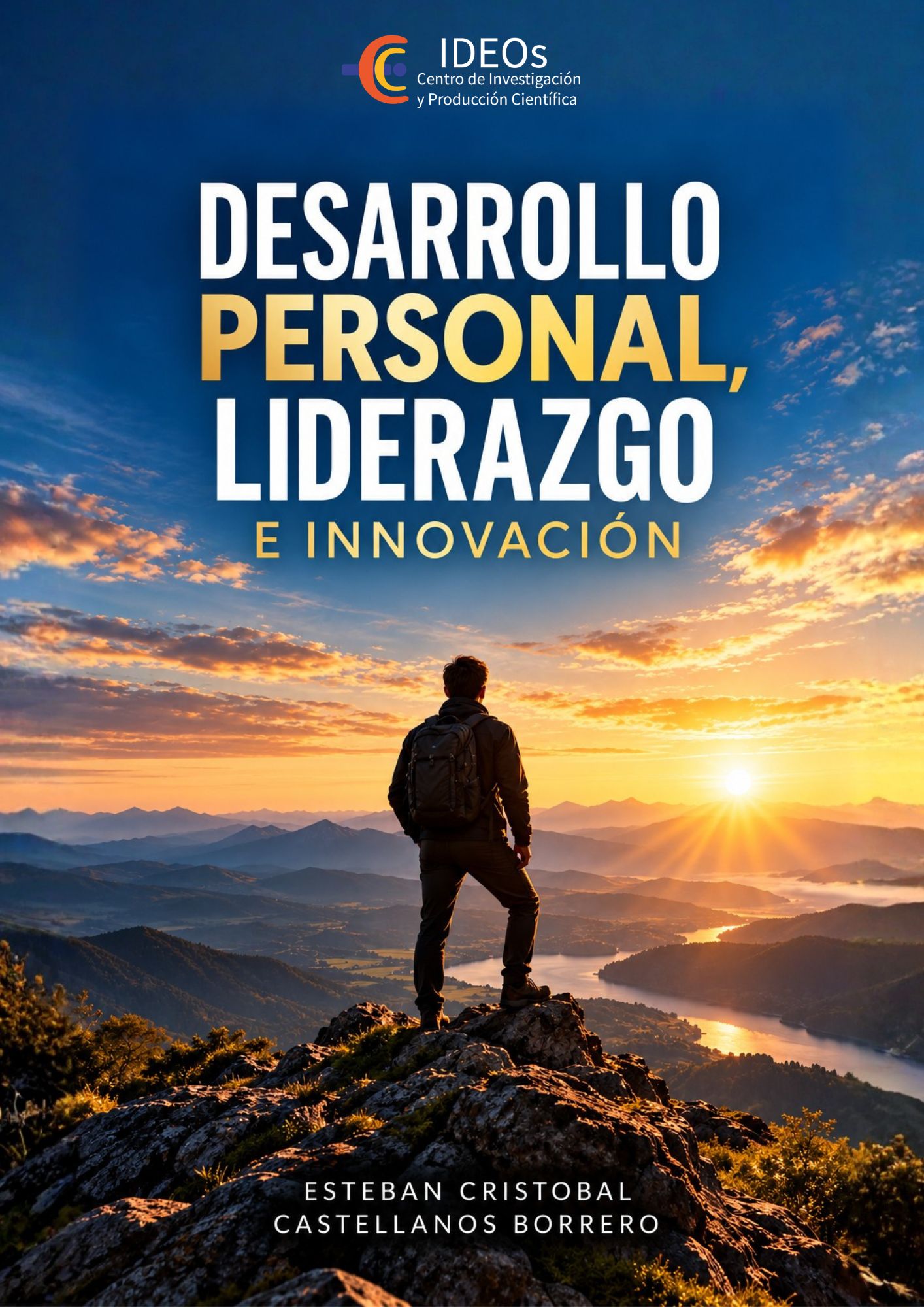
Desarrollo personal, liderazgo e innovación
Resumen
Las personas atraviesan a lo largo de su vida múltiples cambios que influyen en su forma de pensar, sentir y actuar. Gracias a ellos logran acomodarse a su entorno, y sus capacidades van manifestándose paulatinamente.
Dentro del ámbito universitario, este proceso cobra importancia porque el alumnado no solo adquiere saberes propios de su carrera, sino que además fortalece las habilidades personales, sociales y emocionales que necesita para responder con autonomía a las demandas académicas y laborales.
Citas
Alberti, R. E., & Emmons, M. L. (2008). Your perfect right: Assertiveness and equality in your life and relationships (9th ed.). Impact Publishers.
Amabile, T. M. (1996). Creativity in context. Westview Press.
Aristóteles. (2001). Ética a Nicómaco (J. Pallí Bonet, Trad.). Gredos. (Obra original publicada ca. 350 a.C.)
Baer, R. A. (2003). Mindfulness training as a clinical intervention: A conceptual and empirical review. Clinical Psychology: Science and Practice, 10(2), 125–143. https://doi.org/10.1093/clipsy.bpg015
Bandler, R., & Grinder, J. (1975). The structure of magic I: A book about language and therapy. Science and Behavior Books.
Bandler, R., & Grinder, J. (1979). Frogs into princes: Neuro linguistic programming. Real People Press.
Bass, B. M. (1985). Leadership and performance beyond expectations. Free Press.
Bass, B. M., & Avolio, B. J. (1994). Improving organizational effectiveness through transformational leadership. Sage.
Baumeister, R. F., Campbell, J. D., Krueger, J. I., & Vohs, K. D. (2003). Does high self-esteem cause better performance, interpersonal success, happiness, or healthier lifestyles? Psychological Science in the Public Interest, 4(1), 1–44. https://doi.org/10.1111/1529-1006.01431
Blank, S., & Dorf, B. (2012). The startup owner's manual: The step-by-step guide for building a great company. K&S Ranch.
Bornstein, R. F. (1992). The dependent personality: Developmental, social, and clinical perspectives. Psychological Bulletin, 112(1), 3–23. https://doi.org/10.1037/0033-2909.112.1.3
Boyatzis, R. E. (2008). Competencies in the 21st century. Journal of Management Development, 27(1), 5–12. https://doi.org/10.1108/02621710810840730
Brown, B. (2012). Daring greatly. Gotham Books.
Brown, K. W., & Ryan, R. M. (2003). The benefits of being present: Mindfulness and its role in psychological well-being. Journal of Personality and Social Psychology, 84(4), 822–848. https://doi.org/10.1037/0022-3514.84.4.822
Brundtland, G. H. (1987). Our common future. Oxford University Press.
Burns, J. M. (1978). Leadership. Harper & Row.
Calhoun, L. G., & Tedeschi, R. G. (2006). Handbook of posttraumatic growth: Research and practice. Lawrence Erlbaum Associates.
Chiavenato, I. (2009). Comportamiento organizacional: La dinámica del éxito en las organizaciones (2.ª ed.). McGraw-Hill.
Coopersmith, S. (1990). The antecedents of self-esteem. Consulting Psychologists Press.
Covey, S. R. (2013). The 7 Habits of Highly Effective People (25th anniversary ed.). Simon & Schuster.
Creswell, J. D. (2017). Mindfulness interventions. Annual Review of Psychology, 68, 491–516. https://doi.org/10.1146/annurev-psych-042716-051139
Day, R. A., & Gastel, B. (2022). How to write and publish a scientific paper (9th ed.). Cambridge University Press.
De Dreu, C. K. W., & Weingart, L. R. (2003). Task versus relationship conflict. Journal of Applied Psychology, 88(4), 741–749. https://doi.org/10.1037/0021-9010.88.4.741
Doidge, N. (2015). The brain's way of healing: Remarkable discoveries and recoveries from the frontiers of neuroplasticity. Viking.
Doran, G. T. (1981). There's a S.M.A.R.T. way to write management's goals and objectives. Management Review, 70(11), 35–36.
Drucker, P. F. (2006). The practice of management. HarperCollins.
Duarte, N. (2010). Resonate: Present visual stories that transform audiences. Wiley.
Dweck, C. S. (2006). Mindset: The new psychology of success. Random House.
Ekman, P. (1992). An argument for basic emotions. Cognition & Emotion, 6(3–4), 169–200.
Fagerberg, J., Mowery, D. C., & Nelson, R. R. (Eds.). (2005). The Oxford handbook of innovation. Oxford University Press.
Ferrari, J. R., Johnson, J. L., & McCown, W. G. (1995). Procrastination and task avoidance: Theory, research, and treatment. Plenum Press.
Frankl, V. (2015). El hombre en busca de sentido (ed. revisada). Herder.
Galdón, C. (2018). Los Objetivos de Desarrollo Sostenible y la agenda 2030. IE Publishing.
Gardner, H. (1983). Frames of mind: The theory of multiple intelligences. Basic Books.
Goleman, D. (1995). Emotional intelligence. Bantam Books.
Goleman, D. (2000). Leadership that gets results. Harvard Business Review, 78(2), 78–90.
Goleman, D., & Davidson, R. J. (2018). The science of meditation: How to change your brain, mind and body. Avery.
Guilera, L. (2011). Anatomía de la creatividad. FUNDIT.
Guilford, J. P. (1950). Creativity. American Psychologist, 5(9), 444–454.
Herzberg, F. (1959). The motivation to work. Wiley.
Humphrey, A. (1960). SWOT analysis for management consulting. Stanford Research Institute.
Kahneman, D. (2011). Thinking, fast and slow. Farrar, Straus and Giroux.
Katzenbach, J. R., & Smith, D. K. (1993). The wisdom of teams. Harvard Business School Press.
Kawasaki, G. (2015). The art of the start 2.0. Portfolio.
Kolb, B., & Gibb, R. (2011). Brain plasticity and behaviour in the developing brain. Journal of the Canadian Academy of Child and Adolescent Psychiatry, 20(4), 265–276.
Kotler, P., & Armstrong, G. (2018). Principles of marketing (17th ed.). Pearson.
Kotler, P., & Keller, K. L. (2016). Marketing management (15th ed.). Pearson.
Masten, A. S. (2014). Ordinary magic: Resilience in development. Guilford Press.
Mayer, J. D., & Salovey, P. (1997). What is emotional intelligence? En P. Salovey & D. Sluyter (Eds.), Emotional development and emotional intelligence (pp. 3–31). Basic Books.
Mehrabian, A. (1971). Silent messages. Wadsworth.
Northouse, P. G. (2022). Leadership: Theory and practice (9th ed.). Sage.
OECD. (2020). OECD future of education and skills 2030. OECD Publishing.
OECD/Eurostat. (2005). Oslo Manual: Guidelines for collecting and interpreting innovation data (3rd ed.). OECD Publishing.
Osborn, A. F. (1953). Applied imagination. Scribner.
Osterwalder, A., & Pigneur, Y. (2010). Business model generation. Wiley.
Partnership for 21st Century Skills. (2019). Framework for 21st century learning. P21.
Paul, R., & Elder, L. (2008). The miniature guide to critical thinking. Foundation for Critical Thinking.
Peterson, C. (2000). The future of optimism. American Psychologist, 55(1), 44–55.
Pineda Pérez, P. (2021). Habilidades de comunicación. Universidad Internacional de Valencia.
Project Management Institute. (2021). A guide to the project management body of knowledge (PMBOK® Guide) (7th ed.). PMI.
Pychyl, T. A., & Flett, G. L. (Eds.). (2012). Procrastination and self-regulation: Theory, research, and treatment. Routledge.
Ratey, J. J., & Hagerman, E. (2008). Spark: The revolutionary new science of exercise and the brain. Little, Brown and Company.
Reivich, K., & Shatté, A. (2002). The resilience factor: Seven keys to finding your inner strength and overcoming life's hurdles. Broadway Books.
Rest, J. R. (1986). Moral development. Praeger.
Robbins, S. P., & Coulter, M. (2018). Management (14th ed.). Pearson.
Robbins, S. P., & Judge, T. A. (2017). Organizational behavior (17th ed.). Pearson.
Rogers, C. R., & Farson, R. E. (1987). Active listening. Industrial Relations Center.
Rosenberg, M. (1965). Society and the adolescent self-image. Princeton University Press.
Ryan, R. M., & Deci, E. L. (2000). Intrinsic and extrinsic motivations. Contemporary Educational Psychology, 25(1), 54–67.
Ryff, C. D. (1989). Happiness is everything, or is it? Explorations on the meaning of psychological well-being. Journal of Personality and Social Psychology, 57(6), 1069–1081.
Schraw, G., Wadkins, T., & Olafson, L. (2007). Doing the things we do: A grounded theory of academic procrastination. Journal of Educational Psychology, 99(1), 12–25.
Schumpeter, J. A. (1934). The theory of economic development. Harvard University Press.
Schwartz, S. H. (1992). Universals in the content of values. Advances in Experimental Social Psychology, 25, 1–65.
Shannon, C. E., & Weaver, W. (1949). The mathematical theory of communication. University of Illinois Press.
Simon, H. A. (1977). The new science of management decision. Prentice Hall.
Sinek, S. (2009). Start with why: How great leaders inspire everyone to take action. Portfolio.
Sirois, F. M., & Pychyl, T. A. (2013). Procrastination and the priority of short-term mood regulation: Consequences for future self. Social and Personality Psychology Compass, 7(2), 115–127.
Solomon, M. R. (2018). Consumer behavior (12th ed.). Pearson.
Sousa, D. A. (2022). How the brain learns (6th ed.). Corwin.
Tedeschi, R. G., & Calhoun, L. G. (2004). Posttraumatic growth: Conceptual foundations and empirical evidence. Psychological Inquiry, 15(1), 1–18.
Trilling, B., & Fadel, C. (2009). 21st century skills. Jossey-Bass.
Tuckman, B. W. (1965). Developmental sequence in small groups. Psychological Bulletin, 63(6), 384–399.
Tuckman, B. W., & Jensen, M. A. C. (1977). Stages of small-group development revisited. Group & Organization Studies, 2(4), 419-427.
UNESCO. (2017). Education for sustainable development goals. UNESCO.
United Nations. (2015). Transforming our world: The 2030 agenda for sustainable development. UN.
Valqui Vidal, R. (2009). La creatividad: conceptos, métodos y aplicaciones. Revista Iberoamericana de Educación, 49(2).
Van Knippenberg, D., & Sitkin, S. B. (2013). A critical assessment of charismatic-transformational leadership research. Academy of Management Annals, 7(1), 1-60.
Wallas, G. (1926). The art of thought. Harcourt Brace.
Watzlawick, P., Bavelas, J. B., & Jackson, D. D. (2011). Pragmatics of human communication. Norton.
Weihrich, H. (1982). The TOWS matrix. Long Range Planning, 15(2), 54–66.
Whitmore, J. (2009). Coaching for performance. Nicholas Brealey.
Young, V. (2011). The secret thoughts of successful women. Crown Business.
Yukl, G. (1999). An evaluation of conceptual weaknesses in transformational and charismatic leadership theories. Leadership Quarterly, 10(2), 285-305.
Descargas
Publicado
Cómo citar
Número
Sección
Licencia

Esta obra está bajo una licencia internacional Creative Commons Atribución 4.0.
El autor permite el uso y difusión de los artículos a los lectores y a la revista, por medio de la licencia Creative Commons CC-BY-4.0 (Reconocimiento 4.0). Esta licencia permite que cualquiera distribuya, remezcle, adapte y rediseñe a partir de un trabajo, incluso con fines lucrativos, siempre que se mencione la autoría de la creación original.
Ruta CC-BY-4.0: https://creativecommons.org/licenses/by/4.0/


